Pool chemistry is the foundation of a clean, clear, and safe swimming pool.
Whether you are new to pool care or just want a simpler way to understand your test results, this guide will help you learn a pool’s chemistry levels, the ideal ranges, and how to balance the pool’s water.
Pool Chemistry Parameters to Know and Test
Each chemistry level plays a different role in keeping your pool water balanced.
Salt is also an important chemistry parameter for pools with a saltwater chlorine generator. If you have a saltwater pool, you’ll need to monitor salt levels to make sure the system can produce chlorine properly.
Ideal Pool Chemistry Levels
Each parameter we test must be at a certain level for our water to be truly balanced. If one parameter is too high or too low, that can accelerate the risk of water problems.
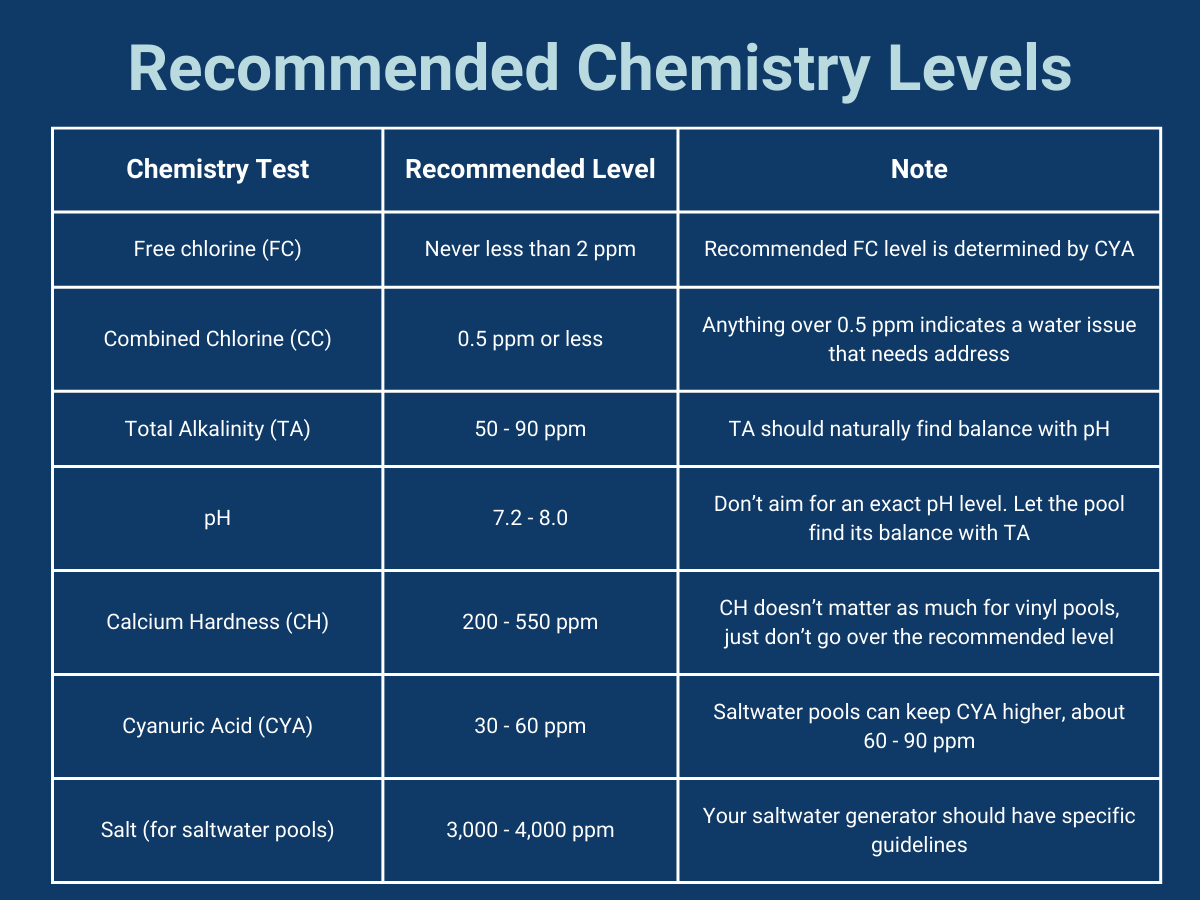
Here are the recommended chemistry levels for each parameter.
What is Balanced Pool Water?
Water can be quite damaging to a pool’s surface. It is in constant contact with vinyl, concrete, tile grout, and various metals
Water can either “corrode” or “scale” such surfaces. This is due to unbalanced water. Conversely, balanced water is water that causes no such damage.
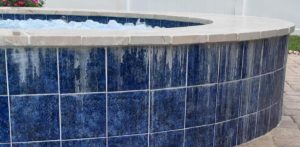
Corrosive water attempts to dissolve concrete and metals, pitting concrete surfaces and damaging copper heat exchangers. The most obvious sign of corrosive water is staining on the pool’s surface.
Scaling water attempts to deposit calcium on surfaces causing white filmy substances or rough calcium deposits on the walls, which can possibly plug up filters and piping.
The goal is always to keep pool water in balance to avoid unnecessary and costly repairs. This is accomplished by ensuring our chemistry levels are always appropriate.
Note that testing methods do not change whether you have an inground pool, an above-ground pool, or a saltwater pool.
The only difference with a saltwater pool is the need for an additional test for salt levels.
Our free pool chemistry calculator tells you if your water is balanced and what to do next.
Using the Right Chemicals
Testing reveals two important details: current chemistry levels and the pool chemicals need to be added if levels are not balanced.
These two go hand-in-hand. The chemistry levels diagnose the problem, and the chemicals treat the problem.
All of these factors work together to achieve water balance and a perfectly swimmable pool.
Further Understanding Your Pools Chemistry Parameters
Having a fundamental understanding of each parameter, including how it increases and decreases, will make pool maintenance much easier
Free Chlorine (FC)
Free chlorine (FC) is the most important chemistry level in your pool because it measures the active amount of sanitizer in the water. This is what kills algae, bacteria, and other contaminants before they can turn your pool cloudy or green.
A Sanitizer is used to kill living organisms and contaminants in the water. While chlorine is the most popular, some pools use bromine instead. You’ll want to learn the many different varieties of chlorine as well as their pros and cons of use.
Your targeted FC level depends on how much CYA is in the water, since stabilizer affects how much chlorine is needed to stay effective. In most cases, FC should be checked daily or every other day, especially during hot and sunny weather when chlorine gets used up faster.
FC is increased by adding chlorine, whether that is liquid, granular, tablet, or produced by a saltwater generator. If FC gets too high, it will usually come down on its own over time with sunlight and normal use.
Combined Chlorine (CC)
Combined chlorine, often called chloramines, tells you how much chlorine has already reacted with contaminants in the water
It is a good indicator that something in the pool is using up your sanitizer, whether that is swimmer waste, organics, or the early signs of a water problem.
CC should stay at 0.5 ppm or lower. Anything above that usually means the pool needs attention and may not be sanitizing as efficiently as it should.
CC is tested alongside FC with most liquid test kits. When CC rises, the solution is usually to maintain or raise chlorine to properly sanitize the water and eliminate the contaminant load.
pH
pH is the overall acidity or basicity of your pool water. It plays a big role in swimmer comfort and whether or not your water becomes corrosive or scale-forming.
If pH gets too high, the water can become scale-forming and less comfortable. If it gets too low, the water can become aggressive and damaging to pool surfaces and equipment.
A good target for pH is usually between 7.2 and 8.0, with many pool owners aiming for the mid to upper part of that range.
pH is usually raised with borax or soda ash and lowered with muriatic acid or dry acid. Since pH tends to drift over time, it is one of the most important levels to monitor regularly.
Total Alkalinity (TA)
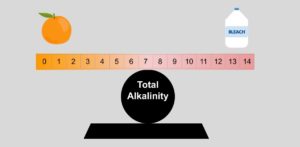
Total alkalinity (TA) helps stabilize the pH balance in the pool. Having at the correct range will save a lot of headaches and wild pH fluctuations
If TA is too high, pH may constantly drift upward. If TA is too low, pH can become unstable and bounce around.
For most pools, TA should generally stay between 50 and 90 ppm, though the right number can depend on how your pool behaves.
Alkalinity is increased with baking soda and lowered with muriatic acid.
Since TA and pH work closely together, it makes sense to look at them as a pair when balancing your water.
Calcium Hardness (CH)
Calcium hardness (CH) lets you know how much calcium is in your water. This is more important if you have a plaster pool, as low levels of calcium can force water to get its source from somewhere else, which is usually the plaster itself and the tile grout.
CH is raised with calcium chloride. If it gets too high, the most effective solution is usually partially draining and refilling with lower-calcium water.
Cyanuric Acid (CYA)
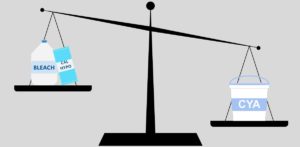
Cyanuric acid (CYA) is chlorine stabilizer. Its job is to protect chlorine from the sun’s UV rays so your pool does not burn through it too quickly.
Too little CYA means chlorine disappears quickly. Too much CYA means you need more chlorine for it to remain effective.
For most pools, CYA should stay around 30 to 60 ppm, while saltwater pools often run a bit higher (60 to 90 ppm).
CYA is increased by adding stabilizer directly. It is also added over time when using stabilized chlorine products like trichlor or dichlor.
If CYA gets too high, the only practical way to lower it is usually by draining and replacing some water.
Salt
Salt is an additional chemistry level that only matters if you have a saltwater chlorine generator. In that case, the salt level must stay in the proper range so the system can generate chlorine efficiently.
Most saltwater pools run somewhere around 3,000 to 4,000 ppm, but the best target depends on the manufacturer’s recommendations for your system.
Salt is raised by adding pool salt, and if it gets too high, it can only be lowered by partially draining and refilling with fresh water.
Bottom Line
If you are coming from a pool service or are generally unaware of the chemicals that were being put in your pool, the initial test that you do with your testing kit will give you a really good idea of how your pool was being treated.
You will get familiar with how your pool behaves pretty quickly and because of that, you will not need to test everything all the time. Now get to testing!