
To properly maintain your pool or spa, you need an accurate testing kit. Each kit contains reagents, specialized chemical solutions in liquid, tablet, or powder form to measure the important chemistry parameters.
Test kits are only as reliable as the chemistry inside the bottles. If you are using reagents that have survived three winters in a garden shed, your readings for chlorine and pH are likely lying to you.
This guide is designed to help you identify exactly which refills you need for the popular testing ecosystems, how to read their specific expiration codes, and how to store them so you aren’t wasting money every season.
Skip to the following manufacturer’s reagent list:



Reagents Shelf-Life and Understanding Expirations
Pool reagents are perishables with a shelf life of roughly 1 to 2 years. While some chemicals (like cyanuric acid) are more stable, others (like DPD power) are highly sensitive to oxygen and moisture.
The three main killers of reagents are:
- Heat: Storing your kit in a 100°F pool shed will degrade the chemicals in a single month.
- Freezing: If a reagent freezes, the chemicals can crystallize and fall out of solution, making the liquid useless even after it thaws.
- Cross-Contamination: Swapping caps between bottles or using a wet scoop in your DPD powder will ruin a fresh bottle instantly.
To properly store your reagents and get the most long-term use out of them, place them in a cool, dry, and dark area when not in use.
Always tighten the bottle caps after using and keep them in their original containers. There is a reason why some light-sensitive reagents are in a brown bottle.
Taylor Technologies Reagents
Taylor is the industry standard for both residential and commercial testing. Their reagents are known for precision titration and accurate readings.
Their reagents are “formulated to remain effective for at least one year,” and is recommended to replace each swim season.
Taylor makes it easy to interpret their reagent expiration dates. The “Best By” date is printed directly on the label. If your bottle is past this date, the chemical may still work, but it is no longer guaranteed for accuracy or reliability.
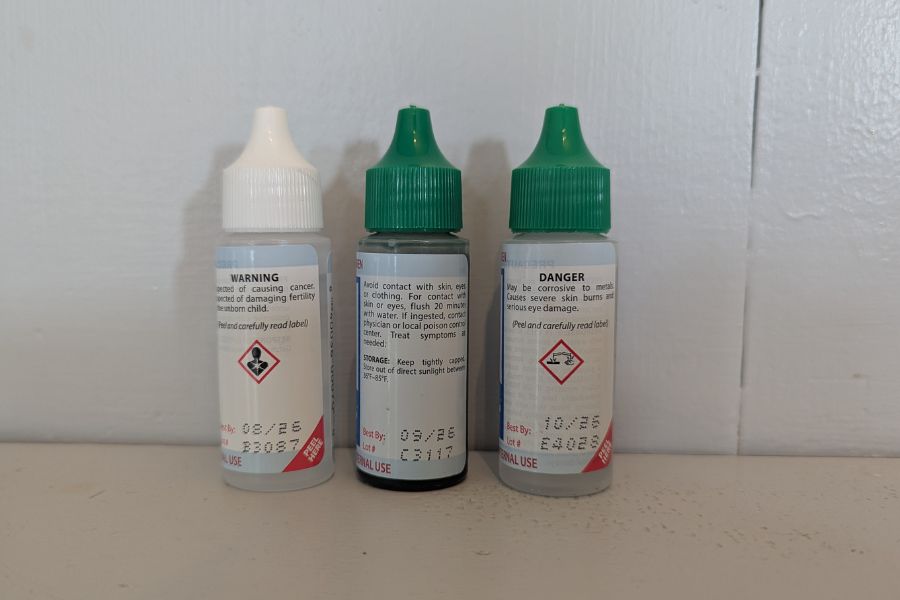
The Taylor Reagent List
Chlorine Testing (FAS-DPD, DPD, and OTO):
- R-0001: DPD #1 (for DPD kits)
- R-0002: DPD #2 (for DPD kits)
- R-0003: DPD #3 (used to test for combined chlorine)
- R-0870: DPD Powder (the pink indicator)
- R-0871: FAS-DPD Titrating Reagent (the drop-counter)
- R-0600: Orthotolidine (for OTO kits)
pH Testing:
- R-0004: pH Indicator (for the 2000 Series large block, like K-2006 and K-2005)
- R-0014: pH Indicator (for the Residential Series small block and TF-100)
- R-1003D: pH Indicator (for Color Wheel comparators)
- R-1003J: pH Indicator (for Midget and Slide comparators)
- R-0005: Acid Demand Reagent
- R-0006: Base Demand Reagent
Total Alkalinity Testing:
- R-0007: Thiosulfate (chlorine neutralizer)
- R-0008: Total Alkalinity Indicator
- R-0009: Total Alkalinity Titrant (sulfuric acid)
Calcium Hardness Testing:
- R-0010: Calcium Buffer
- R-0011L: Calcium Indicator Liquid (detects calcium in water)
- R-0012: Hardness Reagent (detects overall hardness)
Cyanuric Acid Testing:
- R-0013: Cyanuric Acid (CYA) reagent
Saltwater Testing:
- R-0630: Chromate Indicator
- R-0718: Silver Nitrate (the saltwater titrant)
Bromine Testing:
- R-0872: FAS-DPD Titrating Reagent (Bromine-specific drop-counter)
Copper Testing:
- R-0860: Copper Reagent #1
- R-0861: Copper Reagent #2
Iron Testing:
- R-0851: Iron Reagent #1
- R-0852: Iron Reagent #2
Taylor Reagent Sizing
Taylor uses a consistent lettering system to denote the volume of their reagent bottles.
- A: .75 oz (22 mL)
- C: 2 oz (60 mL)
- D: 4 oz (120 mL)
- E: 16 oz (.47 L)
- F: 32 oz (.95 L)
- I: 10 g
- J: .25 lbs (113 g)
When you are looking at a part number like R-0871-C, that trailing letter is the most important part of the code.
If you have a large pool or are planning to perform daily tests, you should almost always skip the “A” size and move straight to the “C” bottles.
The Taylor K-2006 is standard with size A, but you can also purchase a K-2006C kit!
LaMotte Reagents
LaMotte is the other go-to brand for pool testing. They are known for having both liquid and tablet reagents for their parameters.
While not official, LaMotte’s reagents can last for 1 to 2 years if stored in the right conditions.
Like Taylor, the expiration dates are posted right on the reagent bottles, making it easy to see when they should be changed for a fresh batch.
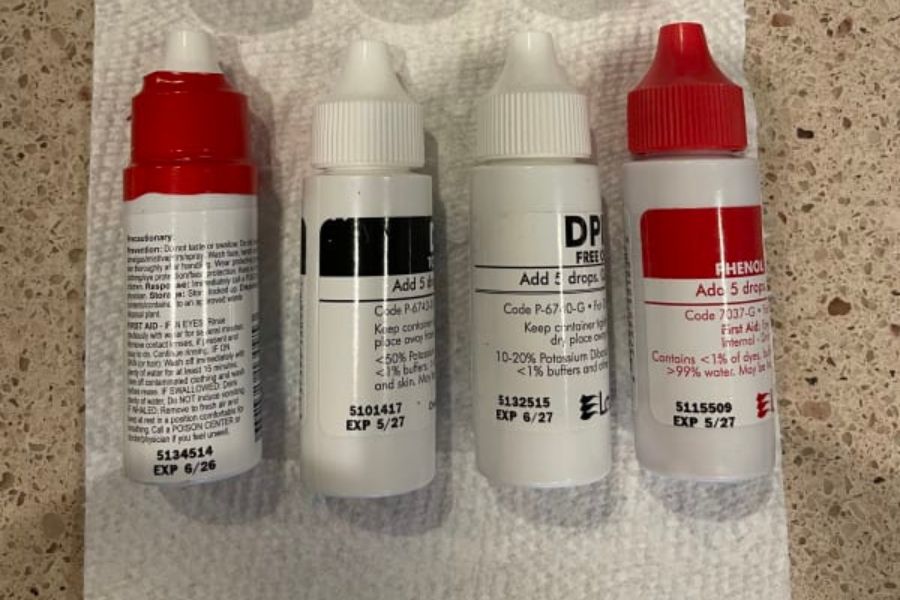
The LaMotte Reagent List
Chlorine and Bromine Testing (liquid and tablets):
- P-6740: DPD #1A (liquid)
- P-6741: DPD #1B (liquid)
- 6999A: DPD #1 TesTabs (tablet)
- 6807: DPD #1 Powder
- P-6743: DPD #3 (liquid)
- 6905A: DPD #3 TesTabs (tablet)
- 3992DR: Chlorine and Bromine Titrant
pH Testing:
- 7037: Phenol Red Indicator (liquid)
- 6915A: Phenol Red TesTabs (tablet)
Total Alkalinity Testing:
- 2786: Total Alkalinity Indicator (liquid)
- 3920A: Total Alkalinity TesTabs (tablet)
Calcium Hardness Testing:
- 7042: Calcium Hardness 1 (liquid)
- 7041: Calcium Hardness 2 (liquid)
- 6846A: Calcium Hardness TesTabs (tablet)
- 5250A: Calcium Hardness Indicator TestTabs (tablet)
Cyanuric Acid Testing:
- 6996A / 6994A: Cyanuric Acid TesTabs tablet)
Saltwater Testing:
- 3824WT: Silver Nitrate (Liquid)
- 3741LWT: Salt Titrant (Liquid)
LaMotte Reagent Sizing
LaMotte also uses letter to denote different sizes in tablets and liquid oz/mL. Take note that lettering can be for both liquid and tablets.
For tablets:
- H: 50 pack
- J: 100 pack
- K: 250 pack
- M: 1,000 pack
For liquid:
- A: 1 mL
- B: 2 mL
- C: 5 mL
- D: 10 mL
- E: 15 – 19 mL
- F: 20 – 24 mL
- G: 30 mL
- H: 60 mL
- J: 120 mL
- K: 250 – 285 mL
- L: 470 – 525 mL
- M: 950 – 1,000 mL
- N: 3,800 mL
For example, P-6740-G is 30 mL of DPD #1A and 6999A-M is a 1,000-pack of DPD #1 TesTabs.
Poolmaster Reagents
Poolmaster test kits are popular at big box retailers and local hardware stores. They aren’t as precise as Taylor or Lamotte, but they can be a good daily checker.
Poolmaster reagents are generally good for two years if they are stored in a cool, dark place when not in use.
Their expiration codes on bottles have 4 numbers and a letter. The first two numbers is the year it was produced, and the last two numbers is the month. The letter is either A, B, C, or D. This represents the week of the month it was made.
For example, 2512C means it was made the 3rd week in December of 2025.
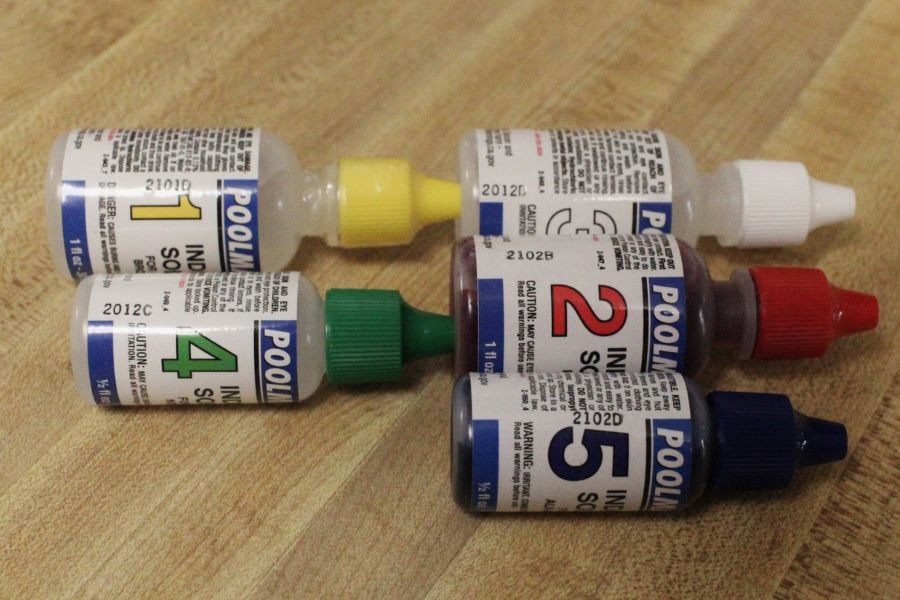
The Poolmaster Reagent List
Chlorine and Bromine Testing:
- Solution #1: OTO
pH and Total Alkalinity Testing:
- Solution #2: Phenol Red (used with 5-Way Test Kits)
- Phenol Red: Phenol Red (used with 2 or 3-Way Test Kits)
- Solution #3: Acid Demand and Alkalinity Test
- Solution #4: Chlorine Neutralizer (used before pH and alkalinity test)
- Solution #5: Total Alkalinity Test
Don’t Mix Reagents From Other Companies
Pool reagents are not “universal” chemicals. Every manufacturer engineers their chemistry to work with a specific drop size, a specific water volume, and a specific color-matching standard.
For example, a Taylor dropper tip is designed to deliver a different volume than a LaMotte tip. If you use Taylor reagents in a LaMotte ColorQ, the digital sensor will read the color density incorrectly.
Using the wrong brand’s chemistry is the fastest way to get “ghost” readings that lead to over-treating your water with expensive chemicals you don’t actually need.