
Every pool owner should have a basic understanding of the swimming pool chemicals they are putting into the water.
Knowing the pool chemistry basics goes hand-in-hand with chemical usage. Once you know what to test, it’ll be easier to understand what to add.
These Are the Pool Chemicals You Actually Need
Pools don’t require many chemicals, and certainly not everything you see on the pool shelf in stores. Some items you might already have in your home are used for other cleaning purposes!
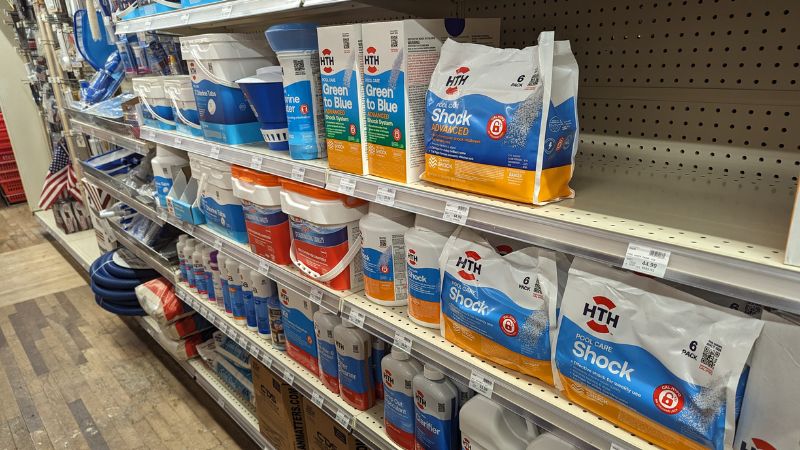
The only chemicals you need to make sure your swimming pool is clean and balanced are:
- Chlorine to increase free chlorine (FC) and as a general sanitizer
- Muriatic acid or dry acid to lower pH
- Borax or soda ash to raise pH
- Baking soda to raise total alkalinity (TA)
- Calcium chloride or calcium chloride dihydrate to increase calcium hardness (CH)
- Cyanuric acid to raise CYA
- Pool salt to raise sodium chloride
Pool Chemicals You Don’t Need
A lot of chemicals you see at the store are not necessary. In fact, some may even be more harmful than helpful. Any product that has copper can have long-term negative effects like staining that is extremely difficult to remove
Keep these chemicals on the pool shelves moving forward:
- Algaecides: The biggest waste of money if you want my opinion. Algaecides don’t kill algae, just prevents it. Chlorine prevents and kills algae!
- Pool clarifiers: These just bind smaller particles into larger balls to get caught in the filter. Keep your pool balanced and you never need this.
- Metal sequestrants: These should only be used if metals are known to be in the pool. These don’t prevent metals in the water, only prevent them from staining
- Phosphate removers: Phosphates are algae food, and algae is bad. However, if you keep proper chlorine levels, algae can’t grow anyway, making phosphate removers unnecessary for most pools.
- Flocculants: Floc binds particles together so they sink to the bottom to be vacuumed. Like clarifiers, a balanced pool will never need floc treatments.
Understanding Each Chemical and How to Use Them
Here is the full list of chemicals and affected chemistry for each:
| Chemistry Parameter | To Raise | To Lower |
|---|---|---|
| Free Chlorine (FC) | Chlorine | Sunlight, fresh water |
| pH | Borax | Muriatic Acid, Dry Acid |
| Total Alkalinity (TA) | Baking Soda | Muriatic Acid, Dry Acid |
| Calcium Hardness | Calcium Chloride | Partial drain and refill |
| Cyanuric Acid (CYA) | CYA | Partial drain and refill |
| Sodium Chloride | Salt | Partial drain and refill |
Sanitizer: Chlorine
Chemistry Parameter: Raising FC, Lowering CC
Chlorine is the most popular sanitizer that helps prevent and kill contaminants in your pool. Depending on your pool’s requirements, it is the one chemical you’d be using daily so you should always have some handy.
Bromine is another sanitizer that can be used, but it typically performs better in warmer water, like hot tubs. Also, once your pool becomes a bromine pool, it is nearly impossible to switch to chlorine without fully draining and replacing your water.
Chlorine comes in many different types, like liquids, powders, and tablets. Liquid chlorine can be added slowly in front of a return jet, while tablets can be put in a floating dispenser.
Granular chlorine should be pre-dissolved in a bucket of water before being poured into the pool.
Muriatic Acid
Chemistry Parameter: Lowering pH, Lowering TA
Muriatic acid helps balance pH and TA by lowering them.
However, it will not lower those levels at the same rate, so make sure you are testing and keeping your levels balanced!
Most big box and hardware store will have muriatic acid either in the pool aisle, painting section, or even in the garden section. If you are uncomfortable, dry acid in powdered form will work just as well. It is commonly sold as pH decreaser or pH down.
Be extra careful when handling muriatic acid. You should wear proper PPE to avoid breathing it in or getting it on your skin. If you splash some on your skin, wash it with fresh water immediately and monitor for any burns.
Add it to the pool by slowly pouring it into the deep end in front of a return jet. You can also pre-dissolve it in a bucket of water or pour it into an acid-resistant container.
Borax
Chemistry Parameter: Raising pH, Slight Raise in TA
Borax is sodium borate used for decades as a laundry detergent cleaning agent. It has also shown its versatility as an ingredient for some insecticides and water softeners.
However, it has recently become widely used as a pH buffer in pools. Borax’s main benefit over soda ash or other pH increasers is its smaller effect on TA levels.
To add, pre-dissolve borax in a bucket of fresh water and slowly pour it in front of a return jet in the deep end.
If particles do not dissolve before they reach the bottom, use your brush to disperse the rest of the borax quickly.
Baking Soda
Chemistry Parameter: Raising Total Alkalinity (TA)
If you go to a pool store and ask how to increase your alkalinity, they will likely give you something like an alkalinity increaser.
The main active ingredient in these products is typically sodium bicarbonate. And what is sodium bicarbonate? Baking soda.
Yes, the baking soda found in every grocery store in the country is used to increase your TA. Usually, buying in bulk and larger quantities can lower the price.
It can be added by simply broadcasting it in the pool’s deep end. If the particles do not dissolve before they reach the bottom of the pool, use your brush and sweep the rest of the baking soda off the surface.
Calcium Chloride
Chemistry Parameter: Raising CH
Calcium chloride can be commonly found in most deicers and ice melts if you live in a colder climate. It is typically the most cost-effective buying as an ice melt in the 30-50 pound bags or buckets that should last you a couple of seasons.
Most pool stores will also sell calcium chloride and dihydrate under names like Calcium Hardness Increaser and Hardness Plus but at much lower quantities and a higher price point.
When adding to the pool calcium chloride should be pre-dissolved in a bucket of water. Fill up a construction bucket 3/4 of pool water and slowly mix the necessary amount of calcium chloride into the bucket.
Stir until it has completely dissolved and slowly pour in front of a return jet in the deep end.
Take precautions, however, as the bucket will get extremely hot. Always ensure safety by wearing gloves and goggles.
Cyanuric Acid
Chemistry Parameter: Raising CYA
CYA is a chlorine stabilizer or “protector” sold in pool stores and most big box stores as stabilizer or conditioner. It works by blocking the sun’s UV rays from degrading your chlorine too quickly.
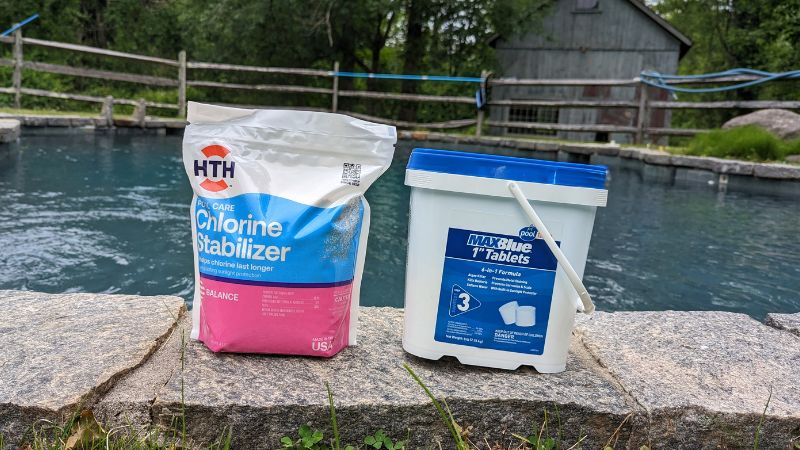
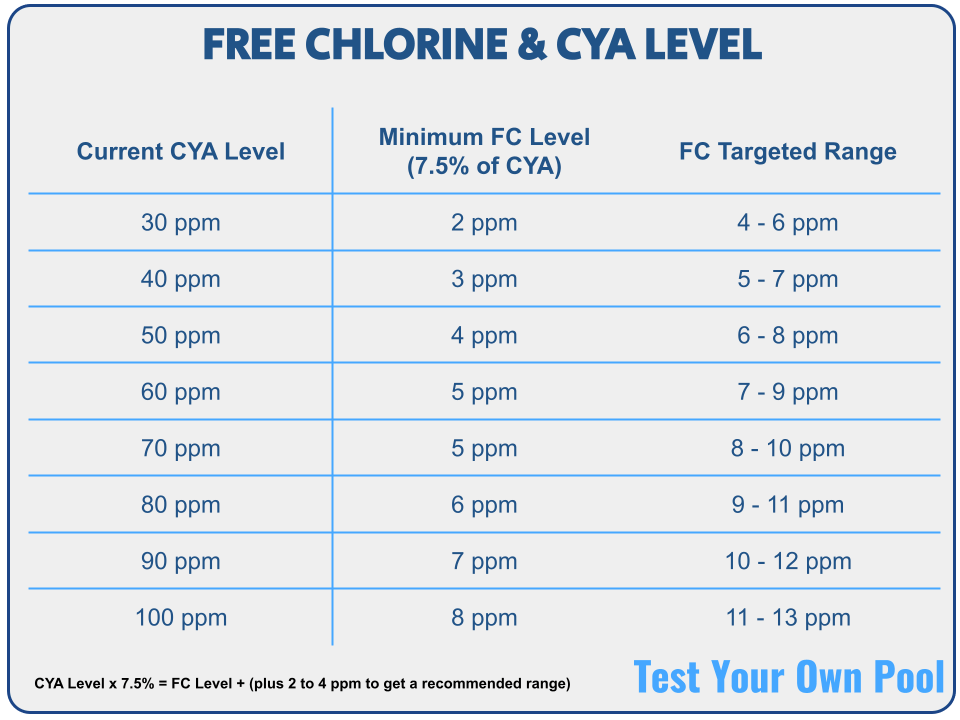
Your FC levels should be determined by the amount of CYA in your water. However, be cautious, as adding too much will force you to use even more chlorine for it to be effective.
The only real solution to lowering CYA is draining water, so you should test your water and know exactly how much to add before doing so.
The most efficient way to add CYA is by utilizing the sock method. Place the amount of CYA needed in a sock, skimmer sock, or nylon stocking.
Tie the sock to the end of a telescopic pool pole and place it so it is suspended in front of a return jet (make sure the sock is not touching the wall as that can stain the surface). After about an hour, squeeze the sock to disperse the CYA further.
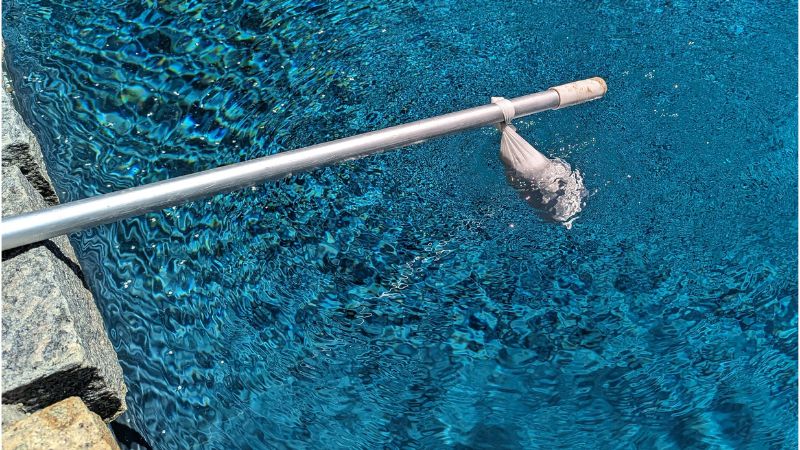
Depending on your needs, this process can take a couple of hours. CYA can be tested the day after the sock fully dissolves in the water.
Pool Salt
Chemistry Parameter: Raising sodium chloride (salt)
For pools, salt is added to a pool to fuel a saltwater generator. The generator uses a salt cell to transform salt into chlorine to sanitize the pool.
The salt used needs to be safe for pools and be >99% “pure” sodium chloride. Solar salt granules to water softeners are also good to use.
It can be added directly into the pool’s deep end. Be prepared to use your pool brush to sweep the bottom to help the granules dissolve quicker.
Where Should Chemicals Be Stored?
Storage for your pool chemicals is important not only for safety reasons but also to prolong the overall effectiveness of each chemical.
They should be stored in a cool, dry, well-ventilated area, preferably away from other household chemicals and flammable items.
Ideally, a shed or portable plastic bin is the best place to store chemicals over the pool season or year-round.

Resin weather-resistant shed to safely store pool chemicals from heat and rain.
While garages might seem like the logical place, compounds that makeup chemicals like acids and oxidizers can rust and corrode metal objects like cars and mowers.
Other Safety Basics to Consider With Pool Chemicals
At the end of the day, these are chemicals we are talking about! Mishandling or misuse can be very dangerous. Follow some basic rules and guidelines when handling chemicals:
- Always add chemicals to water. DO NOT add water to chemicals. This can cause dangerous reactions.
- Never mix chemicals together.
- Always keep pool chemicals in their original containers.
- Never use a chemical in a feeder that isn’t what the manufacturer recommends.
- Always keep out of the reach of children.
Now You Know the Basics!
Understanding the balance between your testing and chemical use will pretty much cover everything there is to know about maintaining pool water.
And, the recommended chemical list is fairly simple.
Of course, some questions and issues will pop up along the way, but know that for most issues that do come up, chances are they start with water that isn’t properly balanced, and chlorine can solve many problems.