
We try to make pool chemistry is simple as possible. Keep your water balanced and your pool will thrive.
Beyond the parameters we want to test, there is a “hidden” metric that determines whether your pool surfaces will stay smooth and pristine or become rough and damaged. This is the Calcium Saturation Index (CSI).
What Exactly is CSI?
The Calcium Saturation Index tells you if your water is overly aggressive or under-saturated, which can cause scaling.
Negative CSI means the water is under-fed. To find the calcium it lacks, it will physically dissolve (etch) it from your pool’s plaster, pebble, quartz surfaces, or tile grout.
Positive CSI means the water cannot hold any more calcium. Instead, it begins to dump the excess onto your pool surfaces and plumbing as hard, crusty scale.
For pool purposes, CSI operates at a scale from -1.0 to 1.0. Ranges are generally classified as:
- Above 0.6: Severe scaling
- 0.3 to 0.6: Scale potential
- -0.3 to 0.3: Balanced
- -06 to -0.3: Etching potential
- Below -0.6: Severe etching
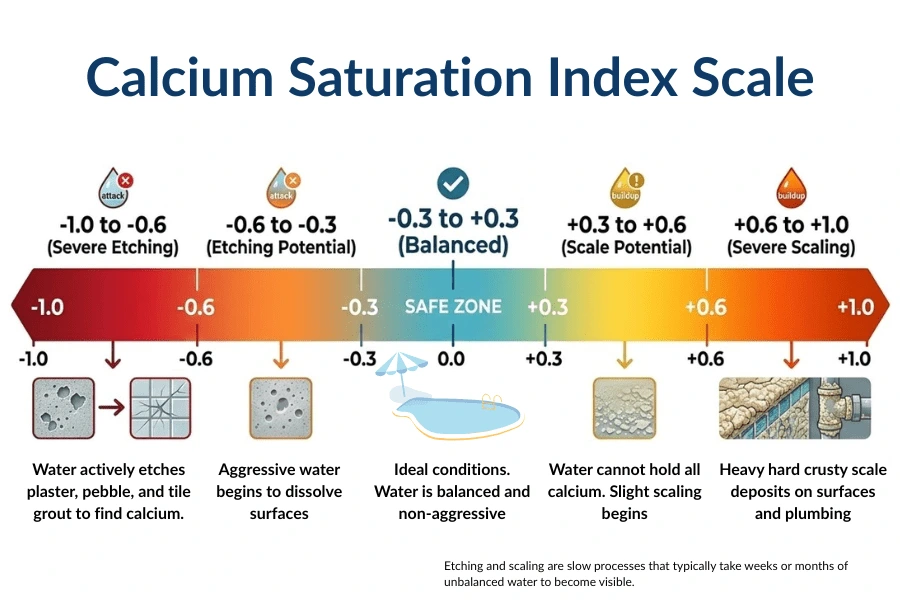
Extremely negative CSI means the water is under-fed. To find the calcium it lacks, it will physically dissolve (etch) it from your pool’s plaster, pebble, quartz surfaces, or tile grout.
On the other hand, extremely positive CSI means the water cannot hold any more calcium. Instead, it begins to dump the excess onto your pool surfaces and plumbing as hard, crusty scale.
Important Note: CSI problems are rarely “overnight” disasters. Etching and scaling are slow processes that typically take weeks or months of unbalanced water to become visible.
How to Find and Calculate CSI
You can find your pool’s CSI by using our pool balance calculator, Poolboy. Input all the parameters and you will get a simplified reading.
In terms of the math, it is calculated mainly by pH, TA, CH, CYA, and temperature. If you want to get into the weeds, Trouble Free Pool has a great resource on the subject
Do You Need to Worry About CSI?
Most pool owners don’t really need to worry about CSI. If you routinely test and try to have your pool balanced, then there is no real reason to be concerned.
As mentioned above, CSI is not overnight. If you happen to let your pH drift up for a day or two, that is no problem.
CSI may be something you should consider taking a closer look at depending on your pool’s surface and location. Even still, it’s something to check, not actively monitor.
Concrete and Plaster Pools are More Susceptible to CSI Fluctuations
Plaster pool owners can monitor CSI as severely negative CSI will start etching the surface.
If you start to see your surface get more rough and pitted, it may be due to a prolonged CSI issue.
Vinyl and fiberglass owners don’t necessarily have to worry about etching. Scale issues can affect any pool, however.
Don’t Forget Waterline Tiles
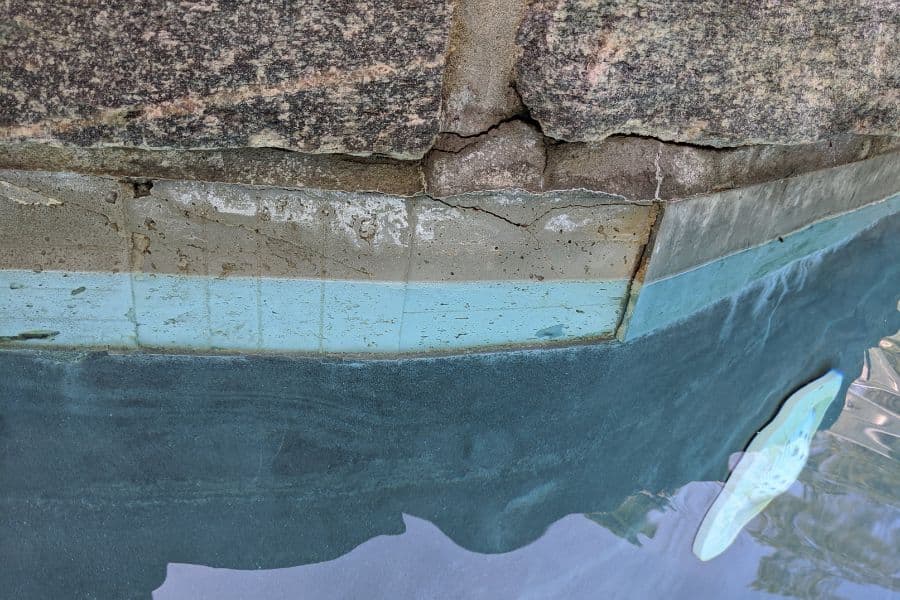
Pools with waterline tiles are also susceptible to etching. Water can eat through the tile’s grout, which then causes water to get behind the tiles and weaken them.
Ultimately they can start to pop off.
Saltwater Pools
If you have a saltwater pool, you’ll notice your pH rise a little more frequently because of the chlorine generation in the salt cell.
If left unchecked, pH can continue to rise and scale can form on the cell plates even if the rest of the pool looks fine. Saltwater pool owners can afford a more negative CSI to counteract this.
Owners Who Close Their Pool
Cold water dramatically lowers your CSI.
When closing a pool for winter, you often need to raise your pH or calcium hardness (CH) to prevent the cold water from eating your plaster during the off-season.
Target Ranges: Finding the “Sweet Spot”
Again, CSI isn’t something to obsess over. As a matter of fact, there is no “perfect” number, nor should you be chasing CSI ranges.
Most pool owners should be happy with anything between -0.3 and 0.3. Saltwater pool owners can afford to be slightly negative because of the higher pH.
What About LSI?
You might have heard of the Langelier Saturation Index (LSI). Think of CSI as an evolution for pool use.
LSI was originally designed for closed-loop water systems like cooling towers and boilers. While it has been used for pools, it didn’t take into account specific chemistry like stabilizers, or CYA.
CSI is simply a more precise measurement for modern pools.
Keep Your Water Balanced And You’ll be Fine!
As mentioned multiple times, CSI shouldn’t be something to worry about. As long as you test, balance, and keep the pool clean, you are good to go!