
Chlorine is the most effective way of preventing and combating organic matter that is potentially living in your water.
Five different types of chlorine can realistically be used to sanitize a pool. One of the more common forms of chlorine is sodium hypochlorite, better known as liquid chlorine or liquid shock.
What is Liquid Chlorine And its Characteristics?
Sodium hypochlorite (formula: NaOCl), or liquid chlorine, is a liquid chemical compound created from reacting chlorine with a sodium hydroxide solution. For swimming pool use, it generally comes in gallon jugs ranging in strength from 10% or 12.5%.
Liquid chlorine is an unstabilized sanitizer, which means it does not contain CYA. In fact, it will not affect any other chemical level in the pool besides FC. This does mean, however, that you will need to manually add CYA.
It is considered pH neutral, but there may be a temporary increase in pH until the chlorine fully reacts with the organic material in the water.
Is Liquid Chlorine the Same as Bleach?
Yes, liquid chlorine and bleach are use interchangeably.
The main difference with bleach is its overall strength per gallon, which is much lower than liquid chlorine. Most bleach has a 3% to 6% strength meaning more bleach will be needed to sanitize the pool.
One important item to note when buying bleach is to make sure it is scentless and devoided of all fragrant boosters and enhancers. You want it to be as “plain” as possible so no extra additives are put into the water.
How to Add Liquid Chlorine to Pool
It is fairly simple once you know how much liquid chlorine to add to the pool. Because it is a liquid, there is no waiting for it to dissolve and no need to brush afterward.
When manually pouring into the pool, pour slowly in front of a return jet in the deep end. It should take you roughly 1 minute to pour a gallon jug into the water.
Another way is to automate the process using a Stenner pump. These peristaltic metering pumps automatically inject chlorine to the required dosage you programmed it for.

How Much Liquid Chlorine to Add?
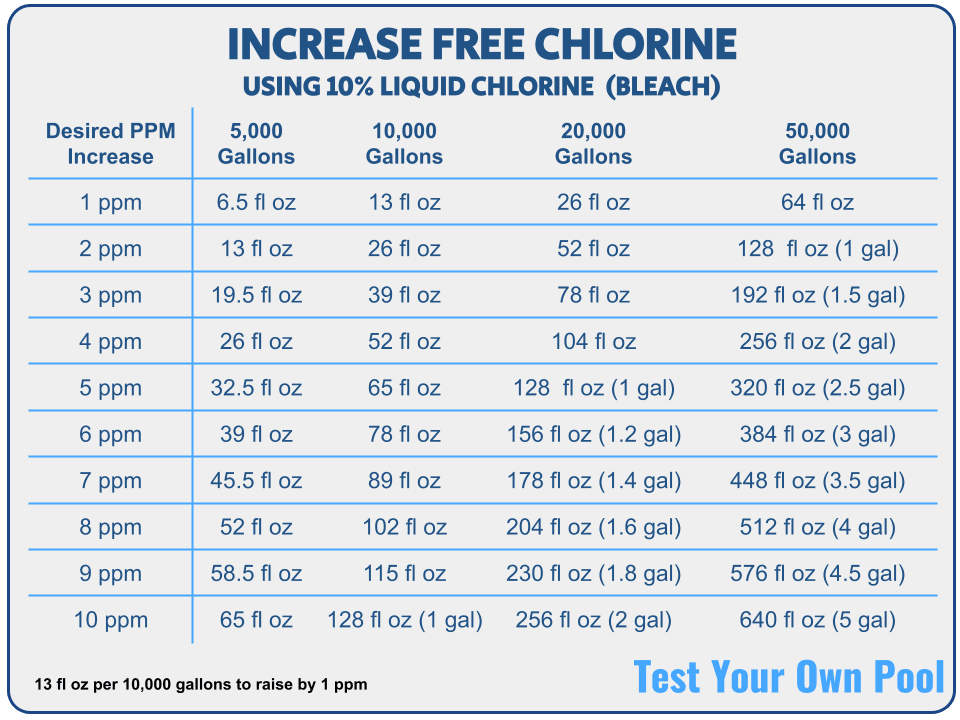
Knowing how much liquid chlorine to add will largely depend on pool sizes. Use our chlorine calculator to find out how much is needed for your pool.
Using 10% strength, it takes about 13 fluid ounces to increase FC 1 ppm per 10,000 gallons.
Take make it a bit easier to comprehend, refer to the dosage graph:
How Often Should Liquid Chlorine Be Added?
Due to its makeup being an unstabilized form of chlorine, it is recommended to test your FC levels daily and add liquid chlorine as needed.
Hotter days can decrease FC by 2 to 3 ppm per day, so staying on top of your chemical levels will help keep the water balanced.
Should Liquid Chlorine Be Your Everyday Choice?
Liquid chlorine is the best type of sanitizer for your pool.
It gives you total control of your chemistry levels, which is ideal. However, you should know some of the drawbacks and limitations compared to other types of chlorine.
Advantages
- There are no additives or effects on other chemistry levels. Using liquid chlorine will only increase FC levels.
- Due to its popularity and widespread use, it is available in big box stores and most pool stores.
- It is relatively cheaper compared to other forms of chlorine. With the recent shortages of trichlor tabs, chlorine jugs became a more appealing choice due to their lower cost.
- It is fairly easy to use and add to your pool. There is nothing that needs to be done after adding to the pool.
- liquid chlorine is the preferred chlorine choice for shocking your pool.
Disadvantages
- Liquid chlorine will degrade over time. If stored at higher temperatures, chlorine strength can be cut in half after only a few months. If buying in bulk, make sure it’s only for the current season, as the strength will be severely limited the following year.
- Since most liquid chlorine comes in gallon jugs, purchasing multiple jugs can be quite cumbersome. Carrying 15 gallons out of the store is no easy task!
- Since it is unstabilized, more chlorine is needed to sanitize compared to tablets and pucks.
What’s the Verdict?
Of all the chlorine options, liquid chlorine should be your daily choice. While a bit of a pain to carry, the advantages should outweigh the burden.
There is comfort in knowing nothing else is being affected by a chemical addition.