
Alexa, play “It’s the Most Wonderful Time of the Year.” That’s right! Spring is here, the birds are chirping, and the pool is ready to lift its cover. It’s time to open your inground pool!
Knowing when to open the pool is important so we don’t open too soon or too late.
Aim to open when daytime air is consistently around 70°F and water is at or below 60°F. Earlier is usually better.
Chemicals Needed
All you need to open the pool are the recommended chemicals used during the season. It is a good idea to have these pool chemicals on hand:
- Chlorine – Preferably liquid chlorine
- Muriatic Acid to lower pH
- Borax to raise pH if necessary
- Calcium chloride to raise calcium hardness (CH) if necessary
- Baking soda to raise total alkalinity (TA) if necessary
- CYA stabilizer to raise cyanuric acid (CYA) if necessary
Avoid the pool start-up kit. These are largely unnecessary and a waste of money.
Steps to Opening Your Pool for the Season
Hopefully, your work to close the pool has paid off, and the water doesn’t look too bad.
It’s not going to be crystal clear, either. Remember, the water has been stagnant for months, so seeing the bottom might be tough with all the dirt and grime.
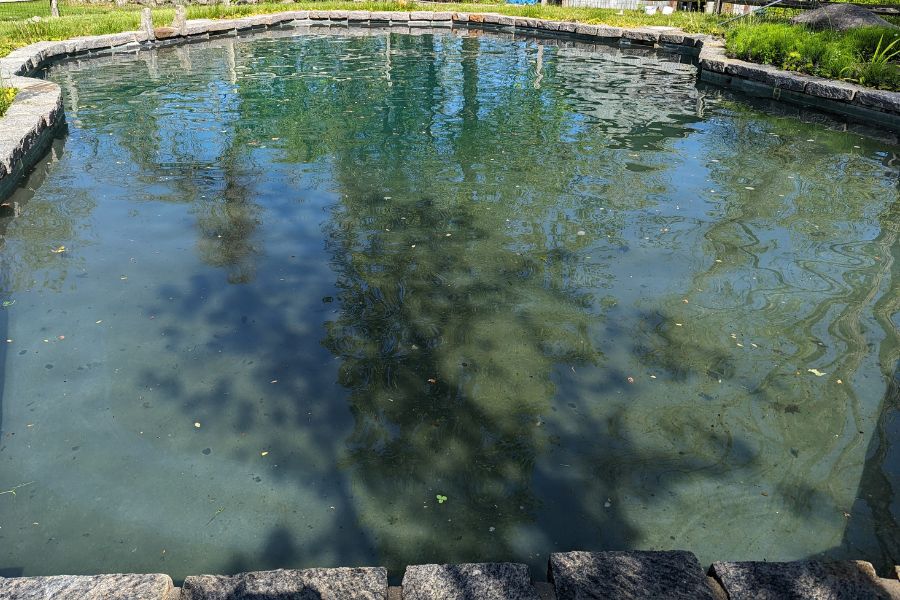
The time it takes to open a pool varies. It largely depends on how dirty the water is. It only takes an hour or two to get the pool set up. However, it can take 2 – 3 days of clearing before it is swimmable.
1. Remove and Store the Pool Cover
- If you have a solid cover, remove any standing water on top.
- Remove the dead leaves, sticks, and any debris that is on top of the cover.
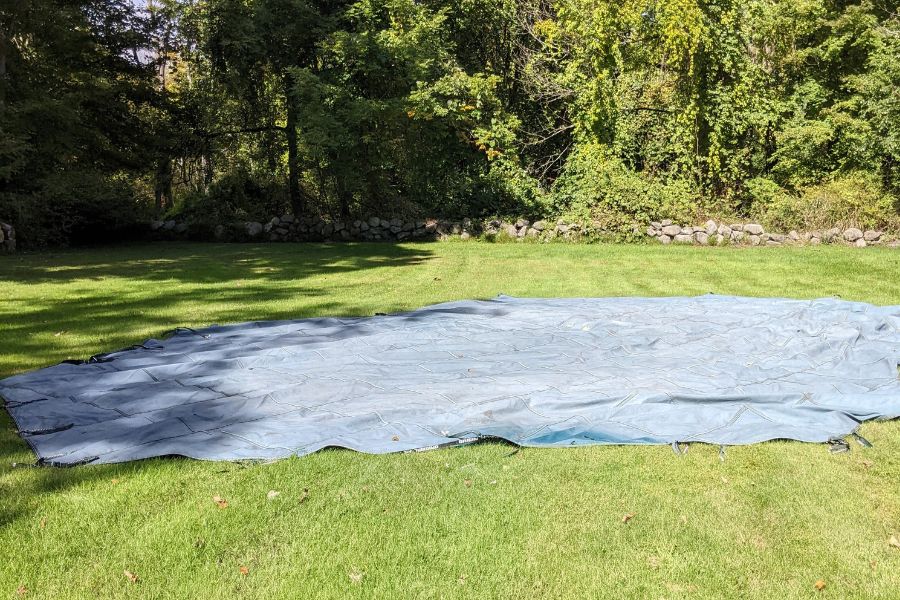
- Take the cover off. This is a good time to check for any holes or tears and repair if necessary.
- Wash it down with a hose and soap solution if you want. Dry it and then store it someplace where mice can’t get to it. (ask me how I know!)
2. Fill Up the Pool if Necessary
- If you need more water, start to fill the pool with a house until it reaches your targeted waterline. This is typically halfway up the pool’s skimmer.
3. Reattach Ladders and Other Pool Equipment
- Reinstall ladders, diving boards, handrails, weir doors, and any other accessory.
- Wipe and hose them down if needed.
4. Remove Plugs and Gizzmos and Install Return Jets
- Remove all winterizing plugs on return jets and skimmers. You may hear water gurgling which is completely normal.
- Reinstall return jet eyeballs and any other necessary plugs.
5. Examine Your Pool Equipment Pad
- Reapply your pool filter’s pressure gauge, sight glass, and any necessary plugs.
- Tip: Use threaded plumber’s tape for a tight seal!
- If your filter has an air relief valve, make sure it is open to start.
- If your filter has a multi-port valve, set it to FILTER.
- Reinstall the drain plugs to the pool pump.
- Ensure all pool valves and ports are fully opened.
6. Turn On the Pump
- Prime your pump if necessary.
- Turn on the pump and listen for the filter to start filling up.
- Close the air relief valve on the filter once water starts to spit out.
- If you have a diatomaceous earth (DE) filter, now is a good time to add DE powder through the skimmer
7. Skim, Brush, and Vacuum The Pool
Regardless if you have a pool robot or not, a manual cleaning is recommended for the initial cleanup.
- Use your skimmer net and telescopic pole to skim the pool surface and floor to remove the larger debris.
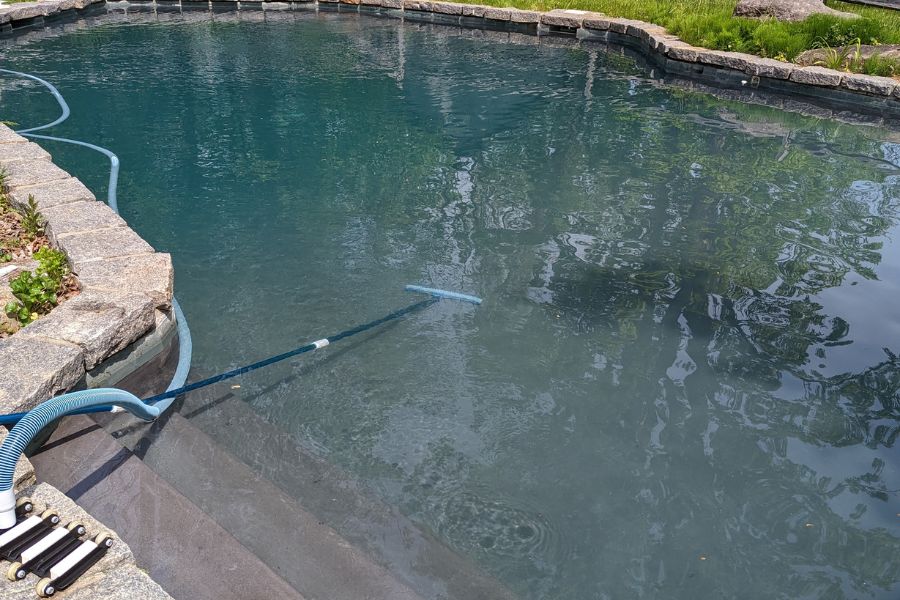
- Attach the brush and scrub the walls, floor, and steps. Dirt and particle sediments should be disturbed at this point.
- After scrubbing, attach the pool vacuum head to the pole and the hose to your skimmer.
- Tip: Use a vacuum plate and skimmer socks to suck in all the debris directly into the skimmer basket rather than the filter!
- If your filter is starting to get full, now would be a good time to clean or backwash it.
- Tip: Steps to backwash sand and DE filters.
8. Test and Balance the Pool’s Water
It is highly recommended to use a testing kit instead of strips. Kits are much more accurate and reliable, which is what we need on the initial startup.
- Run a full set of tests with your testing kit
- Plug in those numbers into a pool chemistry calculator to get a baseline and chemical recommendations.
- Test and re-balance as much as needed.
- If you need to add multiple chemicals, wait 10-20 minutes each addition.

Continuously Monitor Your Pool For a Few Days
Congratulations, the pool is officially open! For the next 24 to 48 hours, the pump should be running continuously to keep the water flowing and filter out debris that hasn’t been caught.
Also, remember that if the weather changes to freezing temperatures (very common in the spring), then be sure to run the pool pump 24/7 to keep the water moving.
The water should be clear and ready for swimming within the next day. Keep testing to ensure that the chlorine is holding.
If combined chlorine (CC) levels are above 0.5 ppm and chlorine levels drop pretty significantly after additions, it may mean chloramines are present, and it’s a good time to shock the pool.
You can also verify other water problems that might be happening.
Have a Great Swim Season
Remember, pool opening starts during closing. A properly closed pool will make the opening go much smoother.
Keep testing, maintain the water balance, and make some lasting memories this pool season!