
Pool testing needs accuracy and reliability. Without it, maintenance can be difficult. Bottom line: Don’t compromise on reliability regarding pool chemistry.
The Taylor K-2006 is the best pool test kit for 2026 because it ends the guessing game to find your chlorine levels. By using the FAS-DPD titration method, you simply count drops until the water sample turns from pink to clear. It is far and away the most accurate kit available.

The most accurate and reliable pool testing kit.
Type of Chlorine Test: FAS-DPD
Read our full Taylor K-2006 Review.
Here Are Best Pool Test Kits Available
Choose from some of the best pool test kits based on your pool’s needs, and experience the convenience of having crystal-clear pool water!
|
Kit |
Best For |
Chlorine Test |
Accuracy |
|---|---|---|---|
|
Best Overall |
FAS-DPD |
Very High |
|
|
Runner Up |
DPD |
High |
|
|
Best Digital Kit |
DPD |
Medium |
|
|
Best Test Strips |
Strips |
Low |
|
|
Best Starter Kit |
OTO |
Low |
|
|
Salt Testing |
N/A |
Medium |
How We Tested
Each test kit features has been used extensively across a full swim season. When a test is performed, all kits are used for better comparisons. We measure performance based on accuracy, reliability, chemistry parameters, and ease of use.
Jump below for more information on our testing environment.
Best Overall Kit
Taylor K-2006
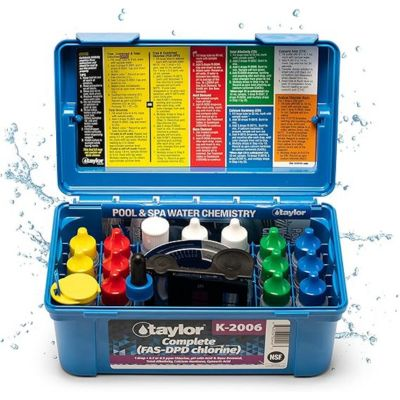
- Included Tests: Free Chlorine, Combined Chlorine, Bromine, pH (including acid and base demands), Total Alkalinity, Calcium Hardness, CYA
- Chlorine Test Type: FAS-DPD
- Price Range: $80 – $100
Pros
Cons
Bottom Line: This is the most accurate testing kit on the market today, and it’s not particularly close. This is a must-have for any pool owner that is serious about keeping their water clean and balanced.
Regarding the best overall testing kit for chlorine users, Taylor’s K-2006 kit is hard to beat. Taylor Technologies is the most trusted name in pool water testing, and there is no other complete test on the market. It tests for all the necessary chemistry parameters and includes a bromine test.
Whereas other tests provide ranges, I found that the K-2006 had more precision, making chemical additions much easier. Multiple tests in a row yielded similar results.
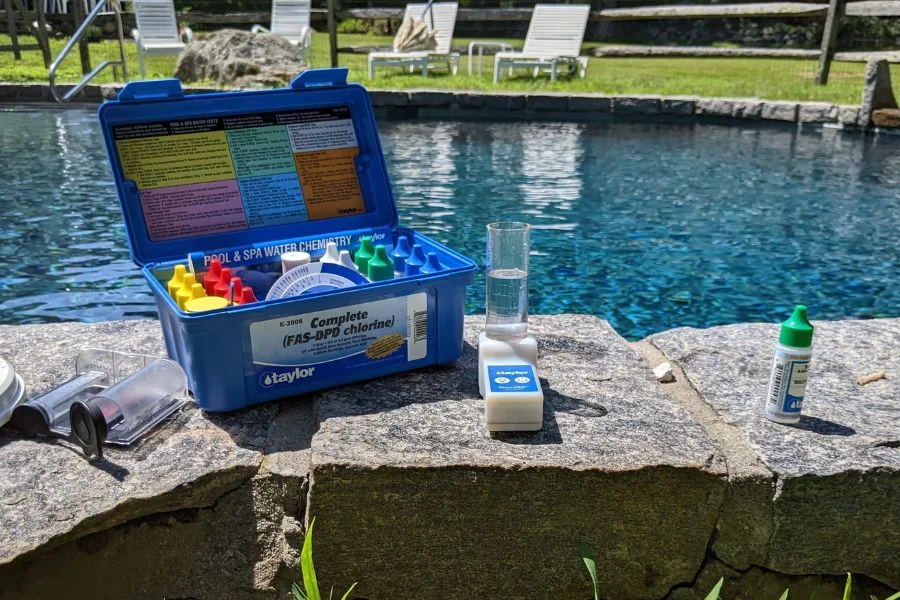
What sets the K-2006 apart from other kits is how it has evolved from its previous models (like the K-2005) by upgrading the way it tests free chlorine (FC).
The FAS-DPD testing method provides a much more accurate reading of FC and combined chlorine (CC). You can get accurate FC readings from 0.2 – 50 ppm!
Read: The Difference Between Chlorine Tests
This method is titration-based, meaning the tests are performed by adding drops until the color of the sample changes, which is much easier and more accurate than looking for a color range that most other tests use.
This alone sets the K-2006 above any other kit.
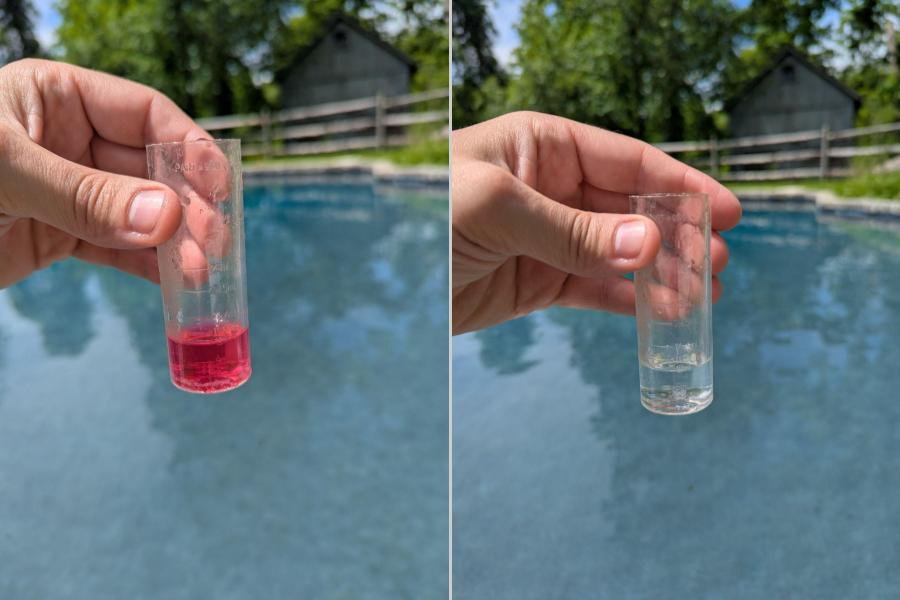
The drop method can get a little cumbersome and confusing, however. To drop, shake vial, drop, shake vial, drop (plus counting each drop) does make the K-2006 a much longer test. Using a magnetic stirrer can help speed up the process, and I would highly recommend it with this kit.
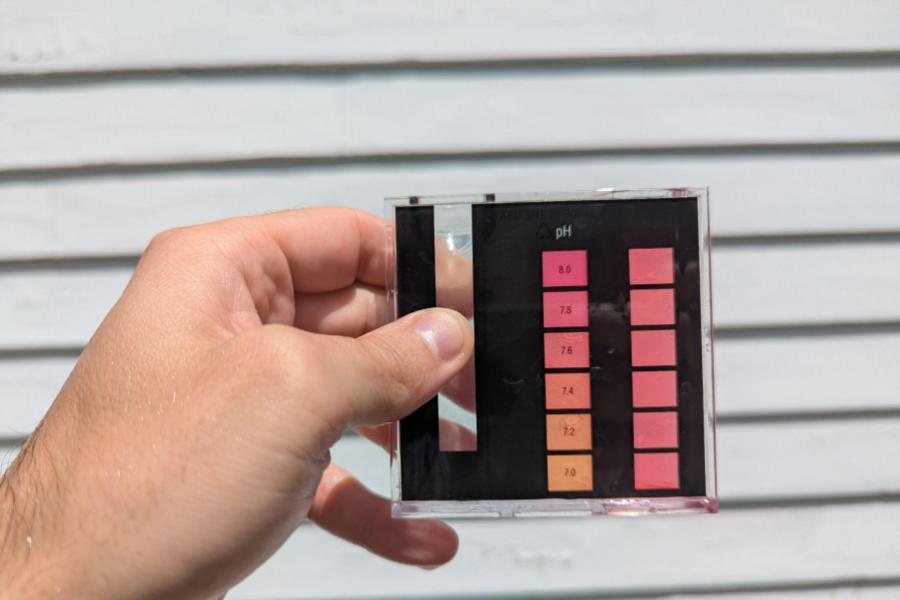
pH tests still use a color-matching system because of the phenol red reagent. This can be hard to get a measurement depending on the pH level itself. However, it is still the most accurate way to test pH.
The kit has a practical carrying case that comfortably holds each of the 0.75 oz reagent bottles. However, depending on how often you test, these bottles might not last all season.
For those that need larger bottles, the larger version K-2006C (complete) is stocked with 2 oz. bottles.
Provided instructions make the testing easier to comprehend, though it may take multiple tests before you don’t need to reference them. Luckily, they are located on the bottom side of the carrying case, making it very convenient to check.
There is also a manual that is a great resource for not only the testing kit itself, but also for understanding what is being tested and troubleshooting issues. For example, it explains that your pH test can be purple when your chlorine levels are above 10 ppm. Quick explanations like this can save headaches later!
Overall, the K-2006 is the kit for those pool owners who take maintenance more seriously than most.
The upfront costs of the kit, including periodic reagent refills, are quite a bit more expensive than other alternatives. However, it’s a worthwhile investment as more accurate readings can lead to more accurate chemical additions and less worry about water getting out of balance.
What Others are Saying
The Taylor K-2006 sees a 4.3 out of 5 star rating from over 3,000 users from its Amazon listing. Most reviews echo what has been said here as being the “gold standard” for testing. While a large majority of the reviews are positive, some users find the kit too expensive and the testing difficult to grasp.
Runner-Up
Taylor K-2005

- Included Tests: Free Chlorine, Combined Chlorine, Bromine, pH (including acid and base demands), Total Alkalinity, Calcium Hardness, CYA
- Chlorine Test Type: DPD
- Price Range: $60 – $75
Pros
Cons
Bottom Line: It’s pretty much the same kit as the K-2006 with exception to how it tests chlorine. The DPD method is a step below FAS-DPD chlorine testing.
Unsurprisingly, two Taylor tests would be at the top of the list. The Taylor K-2005 kit is another great testing kit that provides all necessary tests, including bromine.
The only difference between the K-2005 and K-2006 is how it tests chlorine. It uses the DPD testing method instead of the FAS-DPD test, which makes it a bit less accurate. Combined chlorine is not directly tested but inferred through free chlorine and total chlorine tests.
I found the chlorine test a bit difficult to grasp. The color comparator is tough to differentiate, even when looking at it behind a white wall. A FAS-DPD test is vastly superior, given chlorine levels’ importance in fighting contaminants.
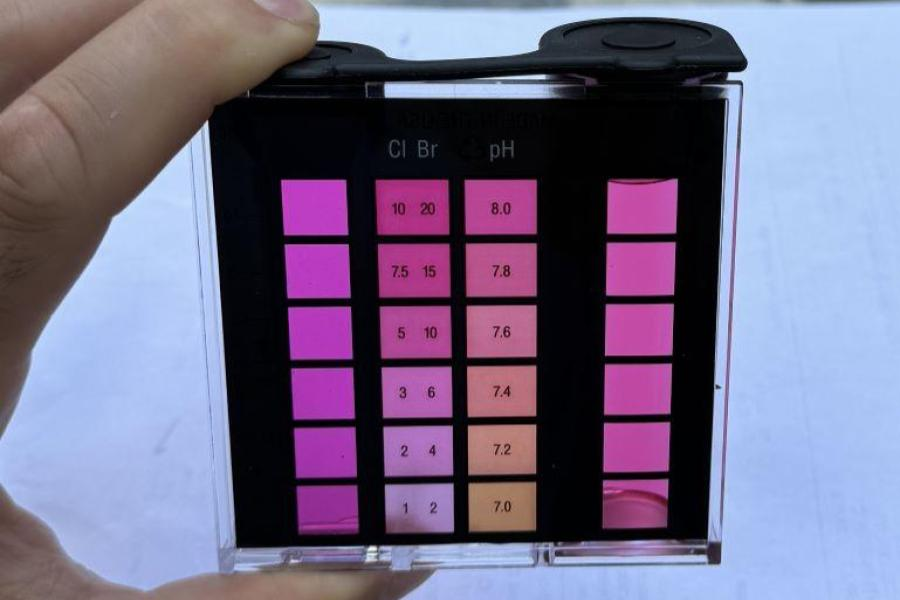
Otherwise, I found no difference in the testing procedures for the other parameters compared to the K-2006.
Like the K-2006, it comes with a convenient carrying case, and the test instructions are labeled on the inside of the case’s lid for easy access.
It is quite a bit cheaper than the K-2006, making it a more attractive option, though the seasonal refills can also add up.
While the FAS-DPD testing is a more reliable, the K-2005 has plenty of upside as a useful testing kit.
What Others are Saying
From 3,400+ raters, the Taylor K-2005 scores a 4.6 out of 5 stars from its Amazon listing, higher than than K-2006. Reviews are generally positive saying how accurate the kit is compared to strips. Like the K-2006, the biggest drawbacks are pricing and difficulty of testing each parameter.
Best Digital Test Kit
LaMotte ColorQ 2X Pro 7

- Included Tests: Free Chlorine, Total Chlorine, Bromine, pH, Total Alkalinity, Calcium Hardness, CYA
- Chlorine Test Type: DPD
- Price Range: $249 – $275
Pros
Cons
Bottom Line: Lamotte is one of the most well-known brands in water testing. While the digital aspect makes testing a lot easier, it’s accuracy of the tests can be an issue.
For those who have trouble with color matching and prefer a simpler testing method, digital kits can help take some guessings out of the equation.
The LaMotte ColorQ 2x Pro 7 is the most well-known digital tester, and rightfully so as it is one of the more reliable digital test kits on the market. With enough reagents to perform 100+ tests, I had no issue lasting a full season without refills.
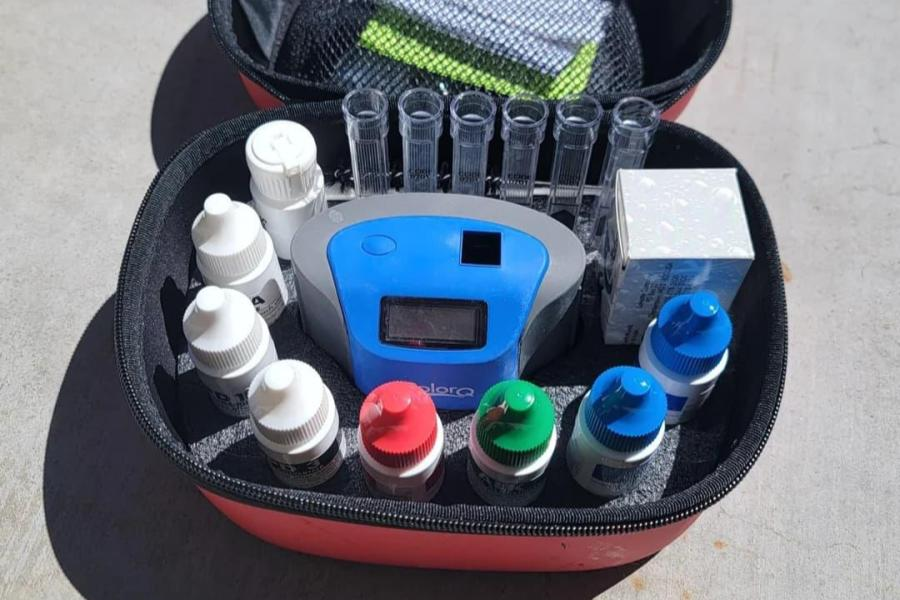
Rather than color-matching, these kits will show you a number as a reading using a photometer. I noticed how much faster it is to perform a full set of tests,
One nice aspect that is often overlooked is its Bluetooth capabilities which can conveniently store previous tests in their app!
The provided instruction manual is very helpful and provides detailed instructions on each test and how to interpret the results.
There are some slight concerns about overall accuracy. When conducting multiple tests back-to-back, I noticed that chemistry readings can vary by 10-20 ppm. For the most part, this isn’t too concerning, but it is worth mentioning.
Also, as it is a DPD chlorine test, combined chlorine again has to be inferred through free chlorine and total chlorine levels.
Digital readers are typically more expensive than other kits, and the ColorQ is no exception. Also, remember that the digital reader can break or malfunction with anything electronic. While the photometer is waterproof, exposure to the sun and water can wear it down over time.
What Others are Saying
The ColorQ sees a 4 out of 5 star rating from 191 users. Most have positive reactions to the simplistic test results, especially for those who are colorblind and have a hard time with strips. Others have notices durability issues with the device breaking after a couple of years.
Best Test Strips
AquaChek Select Connect
- Included Tests: Total Chlorine, Free Chlorine, pH, Bromine, Alkalinity, Total Hardness, CYA
- Chlorine Test Type: Strips
- Price Range: $15 – $30
Pros
Cons
Bottom Line: It’s the best when it comes to testing strips, but that might not be enough when it comes to reliability. Testing strips are notoriously inaccurate and should be accompanied with a kit.
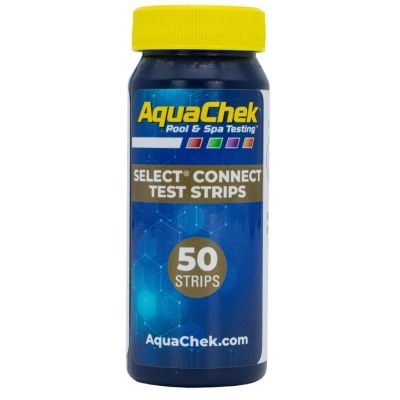
A fast and convenient way to test for both chlorine and bromine pools is with AquaChek’s Select Connect 7-in-1 Strips.
These test strips provide incredibly fast test results, and the great thing about them is it’s just one simple step: dip the stick in the pool and read the results for all seven parameters.
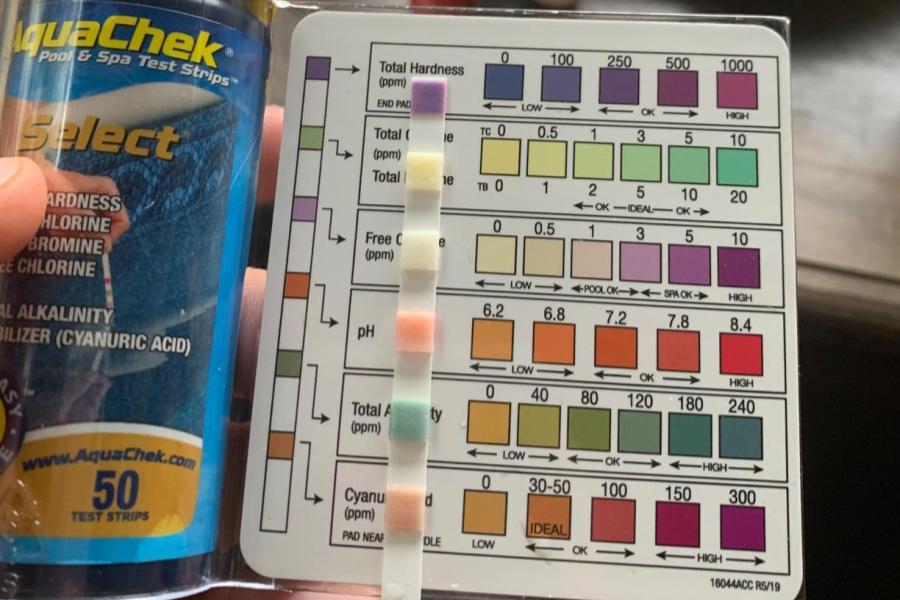
What I like most about AquaChek over other test strips is the ability to take pictures and store results in their app. This allows you to see how your pool behaves on a week-to-week, or even day-to-day, basis.
While the ease and convenience is positive, I have always had issues with the overall accuracy of test strips. This is why I generally recommend drop-based kits over strips.
Like with most test strips, AquaChek comes with a color comparator chart for your tested stick. I am not a fan of estimating most parameters, especially free chlorine, so it is tough to get a reliable result.
One issue in particular is with total hardness. All strips will test total hardness instead of calcium hardness. Total hardness is a combination of calcium and magnesium in water.
It is very important to get a true calcium hardness test to know how hard or soft the water is, particularly with plaster pools. Strips cannot do this which is a major downside in my opinion.
However, on the positive side, doing multiple tests in a row yielded pretty much the same results for each strip so the test itself is pretty accurate.
I still think test strips have their place in overall pool testing, and the 7-in-1 Strips are definitely a step above other strips.
What Others are Saying
AquaChek has a respectable 4.2 out of 5 star rating from nearly 2,000 users on Amazon. While a lot of users appreciate the easy use of the strips, a large majority are questioning the accuracy of the tests.
Best Starter Kit
Poolmaster 5-Way Test Kit

- Included Tests: Chlorine, Bromine, pH (including Acid Demand), Total Alkalinity
- Chlorine Test Type: OTO
- Price Range: $20 – $30
Pros
Cons
Bottom Line: It’s cheap and easy to use, but that might be all you’ll get for positivity. It’s a decent kit if you are just starting out, but you’ll be fighting accuracy issues on each sample used.
A much more affordable testing kit comes from Poolmaster. The 5-way test kit can be used for chlorine and bromine users, and the color-coded tests are a bit easier to read than others.
As with the other tests, this kit comes with a very handy carrying case and an easy-to-understand set of directions for testing.

This kit is hard to beat in terms of ease of use and the ability to understand the testing methods. On average, I ran through the full testing parameters in about 2 to 3 minutes. However, this is largely due to what is missing from this kit.
There is no testing for calcium hardness or CYA, two important chemistry readings. Even if they don’t need to be tested as often as the others, you will need another kit to supplement those readings. This kit is not for you if you live in an area with hard water.
Also, OTO is the least accurate form of chlorine testing for liquid based testing kits. This only will give you total chlorine, not the individual tests of free chlorine and combined chlorine.
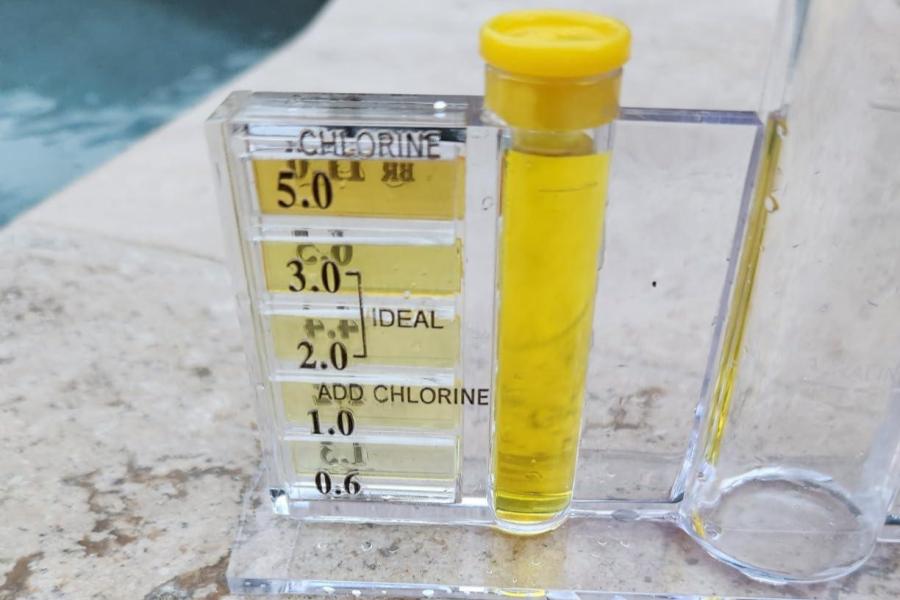
Overall, it is a solid choice if you are looking at a starter test kit or just starting your pool maintenance journey.
However, as you get more comfortable and experienced in testing, this kit will not fulfill full testing results.
What Others are Saying
The Poolmaster kit scores a 4.6 out of 5 stars from over 1,800 raters. Users love the simplicity of the testing and appreciate the carrying case to make testing a little easier. Overall, most agree that it is missing key tests and won’t provide the accuracy needed for weekly testing.
Best Kit to Test Salt Levels
Taylor K-1766
- Included Tests: Sodium Chloride (Salt)
- Chlorine Test Type: N/A
- Price Range: $30 – $40
Pros
Cons
Bottom Line: Accuracy isn’t too much of a concern when testing for salt, so you can’t really go wrong with any salt-only testing kit. However, it’d be my recommendation to stick with Taylor.
Owners of saltwater pools have the added luxury of not having to worry too much about manually adding chlorine to their pools. But testing is still important!
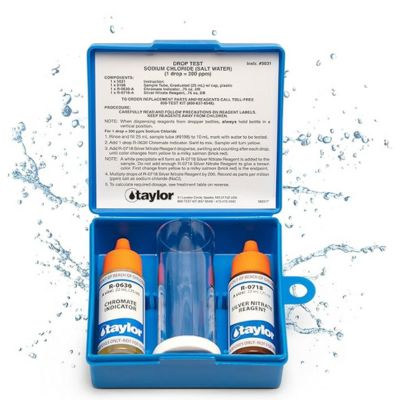
For saltwater pool owners, a great complement to an existing testing kit is the Taylor K-1766 which just measures salt levels.
Since saltwater tests don’t have to be too accurate, each drop of this test is equal to 200 ppm. And like with other Taylor tests, using the SpeedStir can help speed up the drop-based test.
There is no need to buy a separate kit just for salt. A quick check salt test is all that is needed for your saltwater needs!
However, if you are looking to buy a brand new kit with salt testing included, then the best option for that is the Taylor K-2006SALT. It combines the K-2006 and K-1766 into one kit.
What Others are Saying
The K-1766 sees a 4.4 out of 5 star rating from nearly 1,000 users on Amazon. Most users praise it for the accuracy it provides for salt tests. However, a large portion of the reviews question the high price tag for what it tests.
Understanding How Each Pool Kit Was Tested
I’ve tested dozens of kits and listed what I believe are the best for various needs for both chlorine (including saltwater pools) and bromine pools.
All tests listed have been used extensively during a swim season and are reviewed without bias. Kits were used according to the manufacturer’s directions, and no kit was used more than the other. Any time a test was done, all kits were used.
All testing kits work the same regardless if you have vinyl, plaster, inground, or an above-ground pool. There are no specific testing differences between your pool’s surface type.
Accuracy, reliability, and ease of use are key factors for reviews. Keep in mind your results may vary when using the kit day-to-day.
Each kit is also rated by the chemistry testing parameters that are included.
What Should A Pool Kit Test For?
Pool testing kits should provide a chemistry reading for all of the necessary parameters to achieve perfect water balance:
- Free Chlorine (FC)
- Combined Chlorine (CC)
- Cyanuric Acid (CYA)
- pH
- Total Alkalinity (TA)
- Calcium Hardness (CH)
- Salt (for saltwater pool owners)
Different tests are also available based on the type of sanitizer used. The most common testing kits are for chlorine pools. Saltwater pools have a separate test for salt levels in the water. Owners of a bromine pool should use a specific test for bromine levels.
When choosing a testing kit, one item to look out for is how free chlorine (FC) and combined chlorine (CC) are tested. Three testing variations exist for free chlorine levels: OTO, DPD, and FAS-DPD.
How Long Are Test Kit Reagents Good For?
All testing reagents have a shelf life. Most are effective for at least a year. However, storage conditions, not dates, are the most controlling factors regarding reagent expirations.
Ensure reagents are stored in a cool, dry place away from sunlight and in their original containers. Proper storage can prolong reagent use.
Using a SpeedStir to Speed up Taylor Tests
Once you start using drop-based tests, you’ll soon realize that swirling the bottle and dropping reagents can be time-consuming and mentally draining. Who wants to count, drop, and stir at the same time?!
That is where the Taylor SpeedStir Magnetic Stirrer comes in. This stirrer will cut your testing time in half, and the only thing you’ll need to do is drop and count. It might seem like a novelty at first, but once you start using it, you’ll wonder why it doesn’t come with Taylor kits.
Happy Testing!
As stated before, the first step to maintaining your pool is understanding what is in it. Your test kit will be the source of truth for pretty much everything regarding your water. Pretty soon, you will have the recommended levels and the necessary chemical dosages memorized, and your maintenance journey will be less maintenance and more swimming!