
Draining an above-ground pool is quite common. Whether it’s to replace the liner or to store it away for the winter, more likely than not you’ll need to drain it eventually.
It might seem straightforward at first, but if you want to avoid damaging your liner, flooding your yard, or potentially violating any local drainage rules, there’s a right way to do it.
Preparations Before Draining
Before you start to drain, you’ll need to have a plan and check your local laws and guidelines.
First, most municipalities have certain requirements you need to meet before draining. If you plan to use a sewer drain, they may require the water to be free of chlorine and other chemicals. Always check your local laws before draining!
If you are draining to just refill with fresh water, make sure you do so during a milder day. Hot days with the sun blasting down can damage your liner when it is dry and not in contact with water. You’ll need to drain and refill as soon as you can, so either get that hose in right away or have a water truck ready to fill it up.
The Best Ways to Drain Your Above-Ground Pool
The three most practical ways to drain the pool are:
- Using a submersible pump
- Using a siphon
- Using the pool’s drain valve
Using a Submersible Pump
A submersible pump will be the best method to drain the water out of your above-ground pool. It’s easy to set up and should be done in less than a day, depending on the size of the pump, hose, and your pool of course!

Moves up to 1,800 gallons per hour and will lift water up to 25' of vertical height.
Here’s how to drain with a pump:
- Unplug all pool equipment (pump, lights, etc.) to ensure nothing turns on during draining.
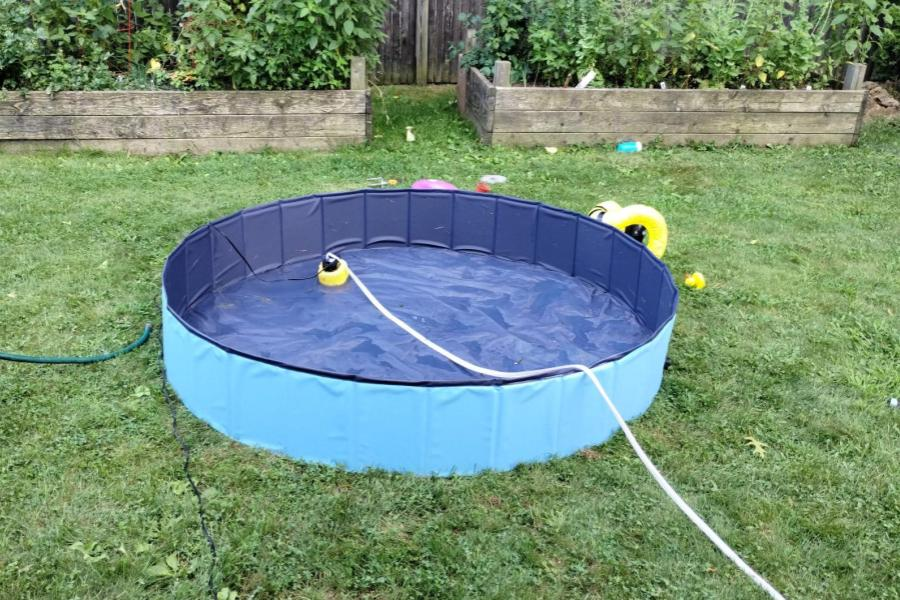
- Attach a garden hose or a discharge hose of choice to a submersible pump and place the pump at the bottom of the pool.
- Direct the hose to a drain point. This can be a sewer, road, yard, or wooded area. Remember to check local laws if draining to the sewer!
- Plug the pump into a GFCI outlet. It should start running at this point.
- Check the drain point to ensure there are no knots in your hose and that the water flows freely.
- Check periodically on your water levels and if the pump is still running.
Creating a Siphon with a Garden Hose
Something a little more practical (and definitely more fun!) would be to create a siphon with your garden hose.
You’ll just need to make sure the endpoint where the water is draining too is lower than the bottom of the pool.
To start a siphon:
- Fill up your garden hose with water. Put the hose in the pool and turn on the spigot. When it is filled, unscrew the hose from the spigot and pinch the end so water doesn’t come out. You want as much water in the hose as possible.
- The hose end in the pool should be at the bottom of the pool.
- Set the other end of the hose at a spot lower than the hose’s end in the pool. Release the pinch.
- This should create a siphon that will continuously suck the water out naturally!
Keep in mind, this is a much slower process and can a day, or longer, to drain. Keep checking to make sure the siphon is still “working” and water is continuously draining.
Using the Pool’s Built-In Drain
A lot of above-ground pools will have some kind of drain valve near the bottom of the pool. This can obviously make draining very convenient.
In most cases, there is a garden hose adapter that screws into the drain hole. Just like a siphon, be sure that the end point is below the drain. You can’t drain upwards!
Removing the Last Few Inches of Water
If you are using a submersible pump, you’ll be able to get most of the water out of the pool with just a few puddles remaining.
Using the drain or a siphon will leave you with a couple inches or so of water left, which is still a decent amount of water.
At this point, you can switch to a submersible pump. You can also use a wet/dry shop vac, a large sponge, or even a towel mop to soak up and remove the last bit.
Depending on the type of above-ground pool, this might be fairly easy or a lengthy task.
What Not to Do When Draining
It’s important to avoid shortcuts when draining, and I already know what you are thinking.
Never cut or puncture the liner to release water. Not only will it ruin the pool, but it can also cause serious flooding and damage. Even if you are throwing it away after draining, it is not a smart move to do this.
Also, avoid draining water toward your home’s foundation or a septic system, as this can lead to long-term problems.
And, as mentioned above, if you leave the liner exposed for too long in direct sunlight, it can dry out, shrink, or crack. That’s why you should plan to either refill it quickly or store it properly after draining.
When You Should Drain an Above Ground Pool
Most framed or hard-walled above ground pools don’t need to be drained every year. In fact, draining them unnecessarily can do more harm than good, especially if the liner is left dry and exposed for too long.
Even if you think you’re water is beyond saving, there are only a few instances where you can’t get it back to normal with chlorine additions and shocking.
With that said, there are a few common reasons why you might need to drain your pool.
Some pool owners drain and store their soft-sided pools at the end of the season, especially in cold climates.
Others need to replace a worn or damaged liner, which often requires a full drain. Sometimes, when the water becomes severely imbalanced or contaminated, draining the pool is the only real fix.
Use Your Brain When Starting to Drain!
Drain your pool right, and you’ll extend the life of your liner, protect your yard, and save yourself from a lot of unnecessary stress.
Whether you’re prepping for winter, changing out the water, or packing things away for storage, using the correct method can make all the difference!